
SORBUS Spotlight: War, the weather and food prices
One of the key political lessons of the post pandemic era has been a reminder, if it was needed, that people – in general – hate inflation.
2022 to 2025 was the worst time on record for incumbent governments facing re-election across the world’s democracies. One big reason for that was simply that things became much more expensive, much more quickly than people were used to. And they really did not like that.
Energy costs – whether the fuel required to fill up a car or the price of heating a home or business – have been a particular point of contention but few things, historically, have had a bigger impact on living standards and hence consumer confidence than food prices. Indeed, long term chart of food prices shows peaks in the late 1840s triggering revolutions across Europe and in the early 2010s correlating rather neatly with the Arab Spring. While food prices in the advanced economies seem unlikely to trigger civil unrest or revolution anytime soon they are developing into a real economic – and hence political – issue.
For all the attention devoted to global energy prices in 2026, it may well be the case that food price inflation is a much bigger issue in 2027.
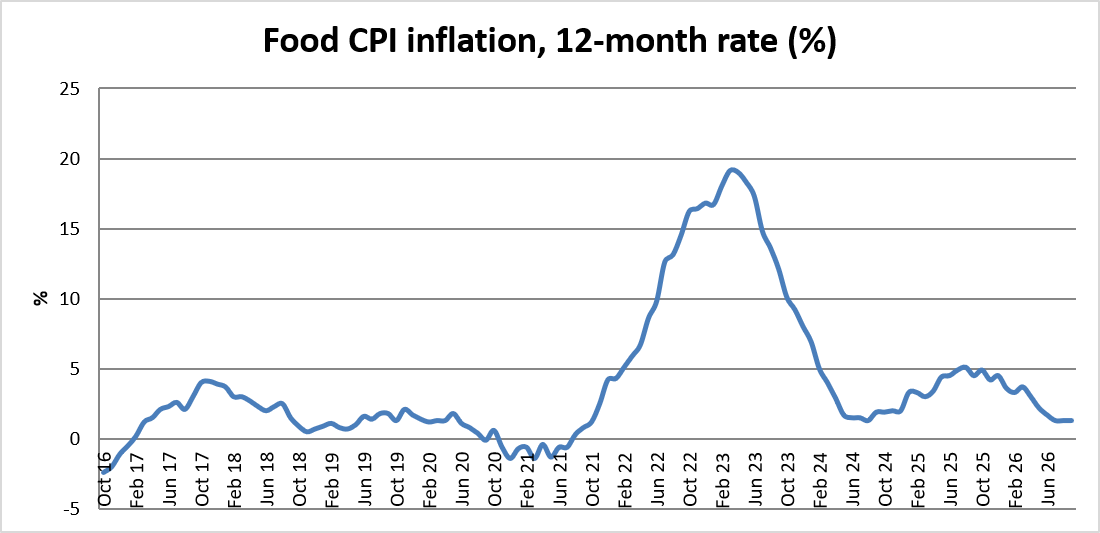
A quick glance at food and non-alcoholic beverage inflation in Britain does not suggest that too much is going on.
source: SORBUS PARTNERS, ONS (data as at 30/10/2026)
The broad story is of a major food price inflation spike in the early 2020s, a dropping off and then a brief resurgence in 2025 before a further period of tailing off. Much of that resurgence was down to large hikes in the minimum wage and employers’ national insurance contributions which put upward pressure on staffing costs, especially at the lower end of the income scale. Britain’s grocers operate on relatively thin margins and this feeds through to prices at the till. That though has now mostly worked its way through the system and, in the absence of shocks, one might expect food prices to continue drifting down.
Sadly the world has not been lacking in shocks.
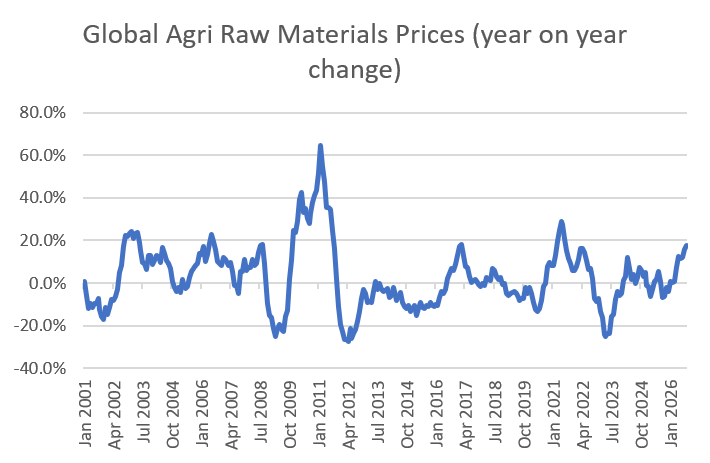
The starting place for any analysis has to be with raw agricultural goods prices at the global level.
source: SORBUS PARTNERS, FRED (data as at 30/10/2026)
Here, as is apparent, a spike is ongoing with price growth now at its highest level since the early 2020s and touching the 20% year on year mark.
The important thing to keep in mind is that there tends to be a delay of between six and twelve months before the price of the underlying food stuff shows up in the price of things on a supermarket shelf.
What is more, and what is more worrying, there are plenty of reasons to fret that we are someway off the peak in terms of raw food price rises.
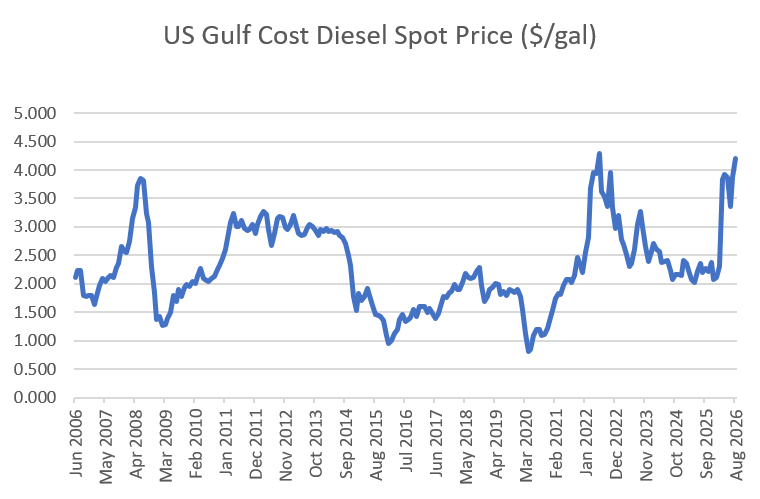
The diminished flows of energy through the Strait of Hormuz are a major factor here.
source: SORBUS PARTNERS, FRED (data as at 30/10/2026)
US diesel prices, used here as a broad proxy for global diesel, are a useful indicator of price pressure facing farmers globally. While diesel, outside of Europe, is a relatively uncommon fuel type for family cars it remains the main fuel for both farm vehicles and for the trucks on which global logistics firms operate.
The large rise in diesel prices increases costs at the start of the agricultural commodities supply chain and, via logistics, also raises them at almost every step from the field to the supermarket.
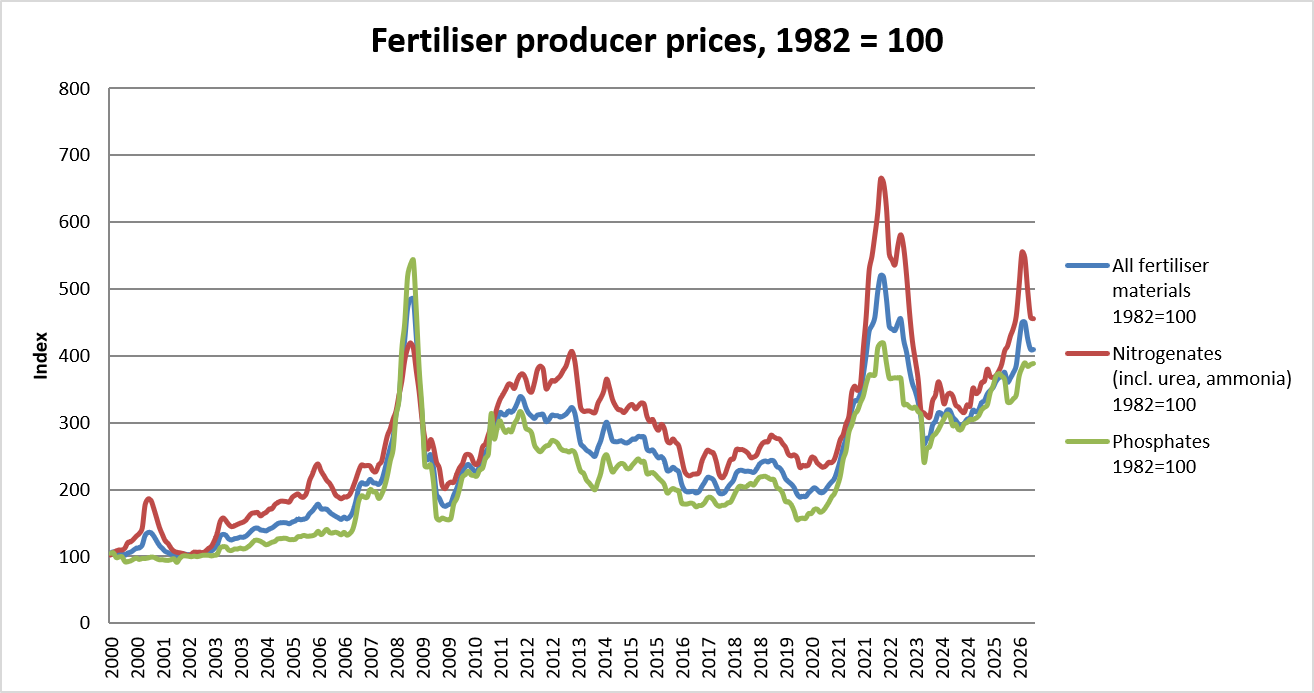
Then there is fertiliser. Qatar, in particular, has played a major role in global fertiliser markets over the last couple of decades as low domestic energy prices have helped it expand production in an energy intensive field. The closure of the Strait has not just reduced the supply of energy available on world markets but also had a serious impact on fertiliser supplies.
source: SORBUS PARTNERS, FRED (data as at 30/10/2026)
Taken together with high diesel prices, this is another cost shock for global farmers. Of course by the time fertiliser supplies were constrained by the war in the middle east and prices rose, the planting season in the northern hemisphere was already well underway and the fertilisers required had mostly been purchased in 2025.
The real impacts of the charts above will not feed through in agricultural commodity prices until 2027. And is unlikely to show up on supermarket shelves until the middle of the year.
Taken together, this all sounds rather familiar to anyone who followed the food price shock of 2021-2023 with supply chain problems (then the result of both lockdowns and the Russia-Ukraine war) feeding through into a nasty spike in the price of eating.
What makes the current outlook more worrying is that, in addition to these familiar issues, farmers are also facing more difficult weather. This summer was, to say the least, rather hot and dry across Europe and North America with worrying implications for agricultural yields. But things look set to get worse.
To understand why, one needs to step away from economics and into the world of pacific weather patterns and wind flows.
Most of the time, steady easterly trade winds push warm surface water west – across the Pacific Ocean – towards Indonesia and Australia, while cold, nutrient-rich water wells up off the coast of South America. Every few years those winds weaken or reverse.
The warm water then sloshes back east across the central and eastern Pacific, and the area of heavy rainfall over the ocean moves with it. Because that tropical convection drives the atmosphere’s large-scale circulation, the shift ripples outward through the jet streams. Rainfall and temperatures change far beyond the Pacific: typically drought in Southeast Asia, Australia, India and southern Africa, flooding in parts of South America and the southern US, and a temporary boost to global average temperatures. An event usually builds over the northern summer, peaks around December and fades within a year. This is what geographers and scientists dub ‘El Nino’.
Typically they happen once every three to seven years but the cycle is somewhat irregular. The last one occurred over the winter of 2022-23, so the gap to the one currently developing is slightly lower than is typical.
Sometimes an El Nino event is unusually strong, these ones are much rarer. The three widely counted as “very strong” in the modern record were 1982–83, 1997–98 and 2015–16, roughly one every 15 to 20 years.
The one currently playing out is, according to weather watchers, unusually strong – a ‘godzilla El Nino’ according to some.
The impacts on a whole host of agricultural commodities look set to be severe. As an El Nino reorganises rainfall rather than cutting it everywhere, they will vary by region. It typically brings drought to Southeast Asia, Australia and southern Africa, and heavy rain to southern South America and the southern US. The crops exposed are rice and palm oil (Indonesia and Malaysia), robusta coffee (Vietnam), Indian sugar and rice through a weak monsoon, Australian wheat, southern African maize, and West African cocoa.
Of course weaker rice and palm oil crops – together with a weaker Australian wheat yield – do not have a major first order impact on the food prices faced by western consumers in north America and Europe. But they do have a major second round impact as domestic food supplies dwindle across a population dense region of the global and these countries seek to import substitutes, pushing up prices globally.
The big difference with 2015-16 is not just that this El Nino looks set to be more severe but that it is coinciding with the existing problems of high diesel and fertiliser prices.
The end result is a serious chance that global soft commodity prices and raw food prices move markedly higher in 2027.
For the UK that could easily mean, unless global fertiliser and energy supplies are restored in short order, food price inflation heading back towards very uncomfortable levels next year. While food price inflation has dropped to just 1.3% this Autumn, the Food and Drink Federation – the industry trade body – expects something like 6% to 6.5% by next summer. That alone, even assuming no further changes in energy prices, would be enough to lift headline inflation by around 1.5% next year.
More worrying still, households are sensitive to food prices and when everyday items rise in price consumer confidence tends to be hit disproportionately.
2026 has been a year of worrying about energy prices. 2027 could well be another year of worrying about food prices.